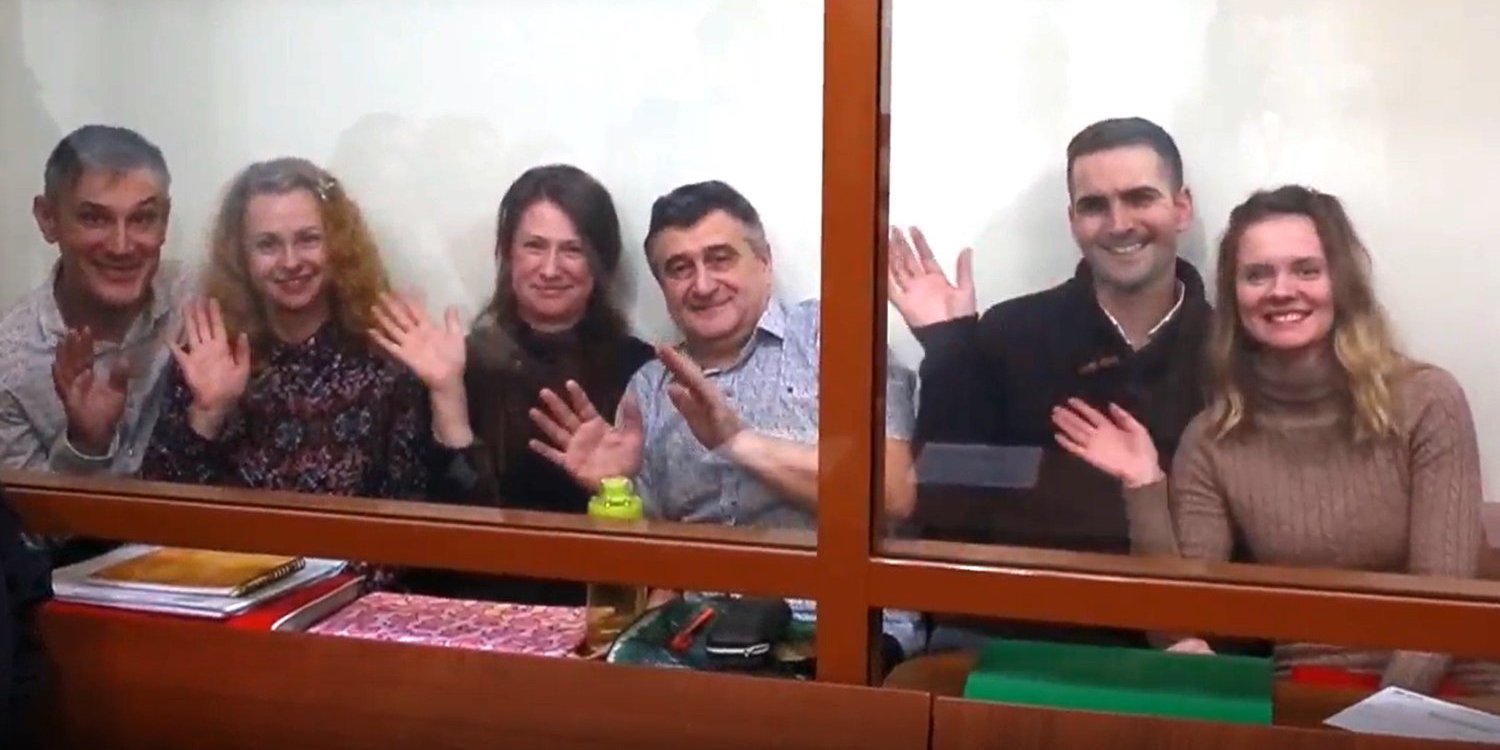
The Anufriyevs, Mikholap, and the Chernobayevs in the “aquarium,” as the glass enclosure in which defendants are held during court hearings is called.
The Anufriyevs, Mikholap, and the Chernobayevs in the “aquarium,” as the glass enclosure in which defendants are held during court hearings is called.
Three Families of Jehovah's Witnesses in Kstovo Sentenced to Lengthy Terms of Imprisonment
Nizhegorod RegionOn November 16, 2026, Judge Sergey Yevdokimov of the Kstovo City Court found three married couples who are Jehovah's Witnesses guilty of extremism. Vladimir Anufriev, Andrey Mikholap, and Viktor Chernobaev were sentenced to 7.5 years, and their wives — to 3 years and 10 months in a general regime penal colony. During their detention, Viktor and Alena Chernobaev were beaten by law enforcement officers; a proper investigation into this has not been carried out.
By the time of the verdict, the believers had spent more than 2 years behind bars. The couples could see each other only rarely; the courtroom was the only place they met. "What was especially hard was being separated from my loved ones," said Oksana Mikholap in her final statement. "While in custody, I have been deprived of the opportunity to hug my family, support my parents, and be with my husband during difficult moments in life." At one hearing, Vladimir Anufriev asked to speak so he could say only one phrase to his wife: "Nastya, I love you very much!"
The trial lasted more than a year. The charges were based on audio and video recordings of meetings for worship that were made covertly over the course of several months, as well as the testimony of secret witnesses, one of whom died before being able to testify in court. During the interrogation of another witness, operative S. Frolov, the Chernobaev couple stated that it was he who beat them during the search of their home in the summer of 2024. In March 2026, while the case was being tried in court, the UN Working Group on Arbitrary Detention, in Opinion No. 30/2026, recognized the detention of the believers as unlawful. The defense presented the opinion of the international organization to the court, but Judge Yevdokimov stated that this document does not oblige the Kstovo City Court to do anything.
In the pretrial detention center, the believers earned the respect of both the administration staff and other prisoners. Anastasiya Anufrieva's cellmates noted that it became calmer in the cell with her present, and two women quit smoking. The area by Oksana's bed was called a "quiet divine corner" by the inmates. Alena Chernobaeva was nicknamed "Little Flower" in the cell, and fellow prisoners said that after she arrived, there were fewer quarrels. One detention center staff member once joked about Anastasiya, Oksana, and Alena: "This is my favorite gang."
In February 2026, while Oksana was in custody, a fire broke out in the home of her elderly parents, resulting in them being hospitalized in a burn center, and her stepfather soon died in the hospital. Despite these circumstances, Oksana was repeatedly denied motions for release from custody.
Prolonged imprisonment has affected the believers' health. Frequent transfers caused Vladimir Anufriev to suffer a back injury; his eyesight also significantly deteriorated. Anastasiya suffered a flare-up of a chronic illness and did not receive necessary medication for a long time. Andrey Mikholap experienced recurring gastritis due to poor nutrition.
The Nizhniy Novgorod Region is among the Russian regions with a large number of criminal cases against Jehovah's Witnesses: in addition to the Kstovo case, there are more than 10 cases initiated here — in Nizhniy Novgorod, Pavlovo, and Shakhunya. Most of these cases have resulted in guilty verdicts; several are still under review.


